
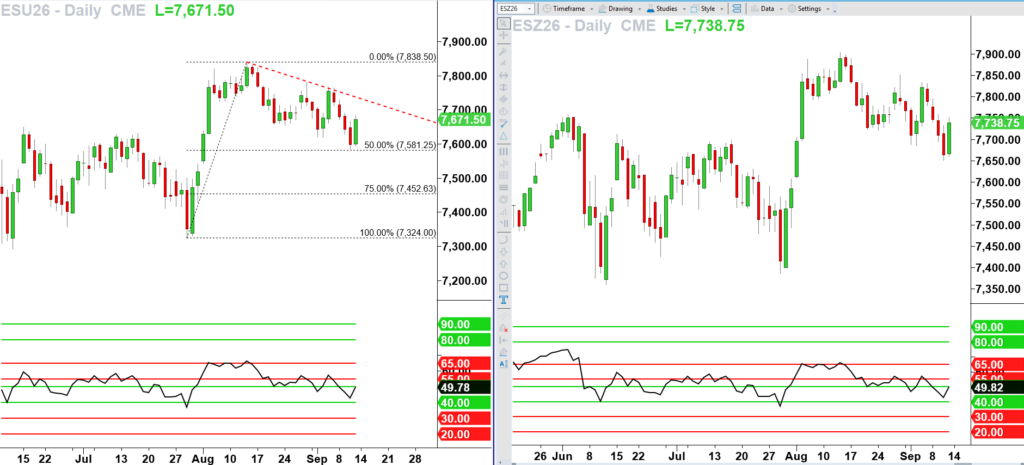
Monday, September 14th is an index futures contract roll date, so I thought this would be a good time to explain what that actually means, especially if you’re newer to index futures, like the ES and NQ.
Even if you only use futures to keep tabs on the broader markets, it’s useful to understand how contract rolls work. And if you trade futures yourself, you definitely want to know when the contract you’ve been watching is about to change.
Stock vs. Futures: The Expiration Difference
Let’s start with the beginner foundation.
A share of stock represents ownership in a company. If you buy 100 shares of Apple, you own those shares, and there is no expiration date attached to them. You can theoretically keep holding them indefinitely.
A futures contract is a standardized contract tied to an underlying market or asset, with specific terms and an expiration date.
So if you’re trading E-mini S&P 500 futures (ticker symbol ES), you’re trading a contract whose value is based on the S&P 500 Index. You aren’t buying shares of the S&P 500 or owning pieces of those 500 companies.
The simple distinction is that a stock doesn’t have a built-in expiration date. A futures contract does.
Because a particular futures contract doesn’t exist indefinitely, as it gets closer to expiration traders generally move their activity into a later-dated contract. That’s what we’re talking about when we say a futures contract is “rolling.”
For ES, the major contract months are March, June, September and December. Their associated letter month symbols are H, M, U, and Z. At this time, we’re transitioning from the September 2026 ES contract, ESU26, to the December 2026 contract, ESZ26.
What I Personally Do When Futures Roll
I keep a wall calendar up where I keep Post-its that tell me what the roll dates are so that I don’t miss them. You can get the dates from this calendar for the ES https://www.cmegroup.com/trading/equity-index/rolldates.html.
The last thing you want to do is be trading a contract that has lost its liquidity.
These roll dates lately have fallen on a Monday. So what I do is use the weekend before to prepare by taking the current charts I’ve analyzed of the contract we’re about to shift away from and updating my chart analysis on the new contract. I bring over annotations, trend lines and the other things I’ve been watching.
That way, I’m ready to trade the new contract on Monday by using the weekend to prepare.
The cool thing is that you’re still analyzing the same market, just through the new contract. A lot of the time, aspects of your key market turning points, support and resistance will be the same, whether you use an intraday chart or a daily chart.
However, the new contract can trade at a premium, meaning at a higher price, or at a discount, meaning at a lower price, to the current contract. So you will observe changes in the actual prices.
Most times those differences willbe very minimal, even just a few ticks or points. You want to be aware of that rather than assuming the price levels will be identical.
I also update my order-entry software tools. If you’re trading on a TradeStation Matrix like I am, you want to make sure that when you start trading the day, you’ve entered the new contract ticker symbol and the order buttons are going to tie to that contract. Along with updating the chart you’re analyzing, make sure the contract you’re actually placing orders for has been updated too.
You’ll see that same transition in my Monday, September 14th ES Futures Outlook report. The prior commentary and recap will reflect the old September 2026 contract, ESU26, while the rest of the ES futures report, and therefore my trading, will reflect the new December contract, ESZ26. I’ll also have a second chart to reflect that updated analysis.
Why Care If You Don’t Trade Index Futures?
It doesn’t matter what you trade. It’s always good to be aware of what the broad US stock market is doing.
Right now, for example, we’re in an environment where the Iran war is directly impacting oil prices. Even if you don’t trade index futures and you only trade say stocks or options on stocks, the costs of doing business for the companies whose stocks you trade can be affected by the price of oil. If a company is responsible for shipping physical goods, for example, its transportation costs can go up.
The relationship can be more complicated than “oil does X, therefore Apple stock does Y.” The broader market environment can still be different.
So even if you don’t trade futures, it is useful to be aware of what these broader markets are doing. One way you can do that is by tracking index futures and other futures markets.
Roll Date vs. Expiration Date
One other distinction that’s important for newer futures traders: the roll date and expiration date are two different dates.
As an individual self-directed trader, it’s generally best to use the rollover date to start trading the new contract so that you’re where the liquidity and trading activity are moving.
By transitioning on the rollover date, you’re also safely into the new contract before the old contract reaches its actual expiration date several days later.
Using the rollover date is the best way to make sure you’ve transitioned into the new contract before the old one expires.
For the E-mini S&P 500 and several other popular equity index futures, traders can track contract roll information directly from CME Group:
CME Group — Equity Index Roll Dates
https://www.cmegroup.com/trading/equity-index/rolldates.html
For me, it’s simply part of the routine. And remember I keep those roll dates on Post-its on my physical wall calendar so I am ready when it’s time to make the switch!
👉 PS — Trader Trainings Coming Up!
The Trader Training calendar has been updated! Here’s what’s on deck:
● Gann Trading Patterns System LIVE Reboot → for Gann Trading Patterns members
📅 Monday Sep 14 at 4:30 PM ET, Wednesday Sep 16 at 4:30 PM ET & Thursday Sep 17 at 12pm noon ET
● First 40 Trading Club: Office Hours Q&A → for First 40 Trading Club members
📅 Monday Sep 21 at 4:30 PM ET
● First 40 Trading Club: Office Hours Q&A → for First 40 Trading Club members
📅 Wednesday Sep 30 at 4:30 PM ET
Visit himareddy.com/events for full details and registration.

Leave a Reply