
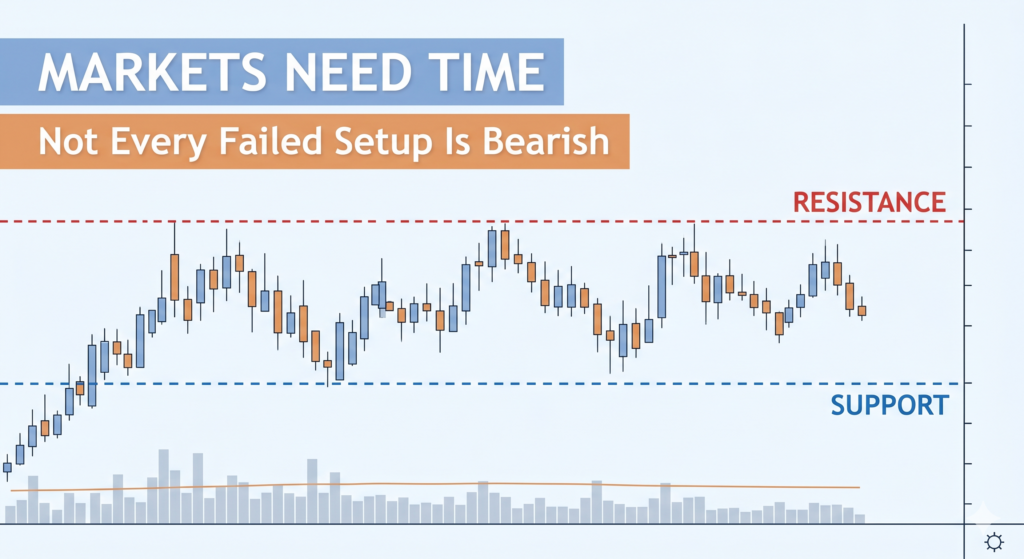
One of the most common mistakes traders make is changing their market opinion too quickly.
You find a setup you like, price starts moving in the direction you expected, and momentum begins to improve. Before long, you’re feeling more confident about the trade.
Then the market stops cooperating.
Price reaches resistance, the advance loses steam, and a pullback begins. The confidence you had a few days earlier starts to fade, and many traders immediately jump to a new conclusion. If the bullish setup isn’t working anymore, then the market must be bearish.
Here’s a better way to approach it.
The Setup Looked Good
During a recent Ticker Request Live session, I was looking at JNJ (April 7 2026) which had returned to Bull Support on the RSI Power Zones. Price was lifting from support, momentum was improving, and the overall picture looked constructive.
Then the stock reached a prior resistance level and started backing off.
What caught my attention wasn’t the chart itself. Charts encounter resistance all the time.
What stood out was how quickly traders tend to abandon their original outlook when a setup stops behaving exactly as expected.
The bullish setup began to work.
Then it stalled.
For many traders, that pause alone is enough to signal the start of a downtrend.
In reality, markets are often more nuanced than that.
Markets Spend Time Deciding
After watching enough charts, you begin to notice how much time markets spend working through periods of uncertainty before making their next meaningful move.
Buyers and sellers may be battling around an important level. A prior advance might need time to be absorbed. New information could be influencing expectations. In other cases, the market simply hasn’t chosen a direction yet.
On a chart, these periods rarely look clean. Price drifts sideways, candles overlap, and momentum gets fuzzy. Compared to the confidence of a strong trend, everything suddenly feels less certain.
That uncertainty can be uncomfortable because traders naturally want immediate answers.
Unfortunately, the market operates on its own schedule.
Many charts go through a period of decision-making before the next move becomes obvious.
A Stalled Setup Is New Information
When a bullish setup begins to weaken, I find it helpful to treat that development as new information rather than a final verdict.
The market is communicating something.
Resistance may be proving stronger than expected. Buyers may need additional time before making another attempt higher. The chart could be transitioning into a consolidation phase. Of course, there’s also the possibility that the advance has run its course.
Early on, several of those outcomes can remain valid at the same time.
That’s why I try not to rush to conclusions.
Many traders feel pressure to immediately decide whether they should be bullish or bearish. They want certainty before the market has actually provided enough evidence to justify it.
A better approach is often to stay observant.
Watch how price responds near support. Pay attention to behavior around resistance. Monitor momentum and look for clues about participation.
Then allow the chart to reveal a little more of the story.
Let the Evidence Build
One of the hardest parts of trading is resisting the urge to react to every small movement. We naturally want answers. We want confirmation that our original idea was either right or wrong.
Markets, however, tend to reveal themselves gradually.
What begins as a pullback can evolve into a consolidation. That consolidation may eventually resolve into a continuation higher. In other cases, the pattern fails and develops into something entirely different.
The important point is that the evidence unfolds over time.
That’s why patience is such an important skill for traders. Patience creates room for observation, allows confirmation to develop, and gives the market an opportunity to show its hand before we commit to a new opinion.
A bullish setup that stalls is often the beginning of a new analysis process, not the end of one.
Give the Market Time
The next time a bullish setup starts working and then suddenly loses momentum, resist the urge to immediately flip bearish.
Instead, take a step back and evaluate what the chart is actually showing.
Has support been broken? Is price simply moving sideways? Is resistance still holding? Has momentum become neutral?
Questions like these are often far more useful than trying to predict the next trend based on a handful of candles.
Just because a bullish setup doesn’t play out doesn’t mean you’re automatically looking at a downtrend.
The market may be consolidating. It may be working through a period of indecision. It may simply be waiting for additional information before committing to a direction.
In situations like these, one of the most productive things a trader can do is remain patient and give the market enough time to reveal its intentions.
👉 PS — Trader Trainings Coming Up!
The Trader Training calendar has been updated! Here’s what’s on deck:
- Ticker Request Live — free weekly trading show
📅 Tuesday, June 23rd at 4:30 PM ET - First 40 Trading Club Office Hours for club members
📅 Wednesday, June 24th at 4:30 PM ET
Visit himareddy.com/events for full details and registration.

Leave a Reply