
I get a lot of questions about whether my forecasting techniques can work in volatile markets — especially when news seems to throw everything off balance.
The short answer: yes, forecasting applies in every kind of market environment.
Whether the market is slow and quiet (rare these days) or racing up and down with choppy consolidations, the principles of forecasting still hold. And I want to share a real example to show you.
Setting the Scene
Here’s a 60-minute chart I captured before the market opened on Tuesday, September 2nd.
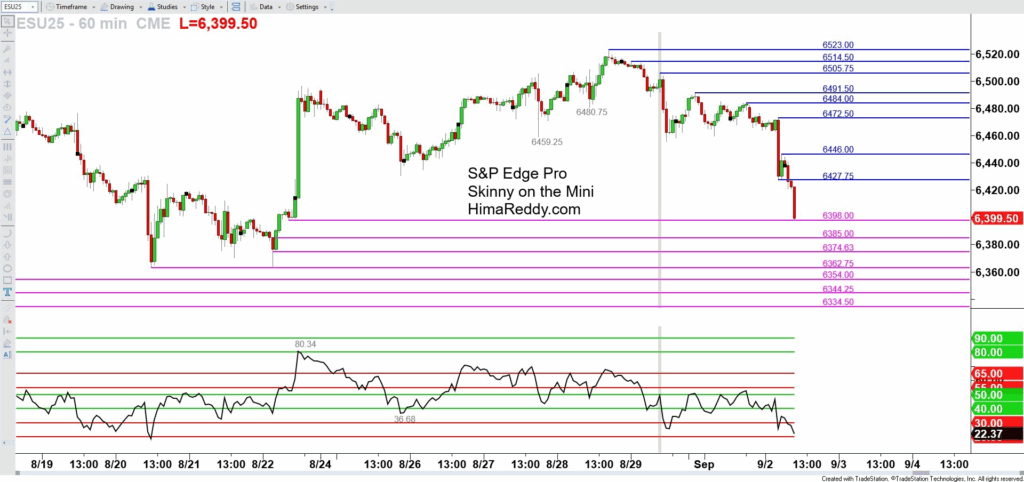
At that point, futures had been falling off the high at 6472.50. This came alongside rising bond yields and fresh tariff-related uncertainty that hit over the holiday long weekend.
Now, if you were a trader opening this chart, you might have thought: with all this news, there’s no way I can gaugewhere this market might be going.
But forecasting gave me clarity.
My Forecast That Morning
In my S&P Edge Pro report on E-mini S&P 500 futures — The Skinny on the Mini — I wrote the following outlook:
“During the overnight, futures have traded lower amid new tariff uncertainty and rising bond yields. The outlook is for futures to continue lower based on a broader forecast. Below 6398.00 would risk 6362.75 near the forecast price component.”
That was my call before the market opened.
Forecasting isn’t about ignoring the news. It’s about identifying time and price relationships that help cut through the noise.
How It Played Out
Here’s what unfolded:
- Futures traded below 6398.00, just as forecasted.
- They initially stabilized at 6383.25.
- From there, they recovered up to 6425.00.
- Then fell again to 6371.75.
Notice that 6371.75 was only 10 points away from the most recent extreme low from August 20th (6362.75).
But more importantly — if you were applying my Lost Forecasting method, you would have recognized that 6371.75 aligned with a forecast providing expectations for a low to form in the market.
The Deeper Lesson
In my teaching, I often say there are two components to forecasting:
- The magnet — that specific point between price and time (if you missed the deeper dive, read Magnets on Your Chart).
- The dynamic zone — the broader area of support or resistance that leads into that magnet.
This slice of price action showed both in effect. Even with volatility, tariffs, and an upcoming Fed meeting creating uncertainty, the forecast levels held weight.
If forecasting can hold up through that, it can be helpful in any types of market condition.
Forecasting isn’t about hovering a crystal ball and trying to predict the future. It’s about recognizing how the securities you are trading – whether individual stocks, options, indices or ETFs -are drawn to certain time-price relationships, no matter what headlines cross the screen.
What about you?
Have you ever noticed price action lining up with a level you mapped out before the news hit? I’d love to hear if forecasting — or even your own support/resistance work — has held up for you in volatile times.
Drop a comment below and share your experience.
~Hima

Leave a Reply