
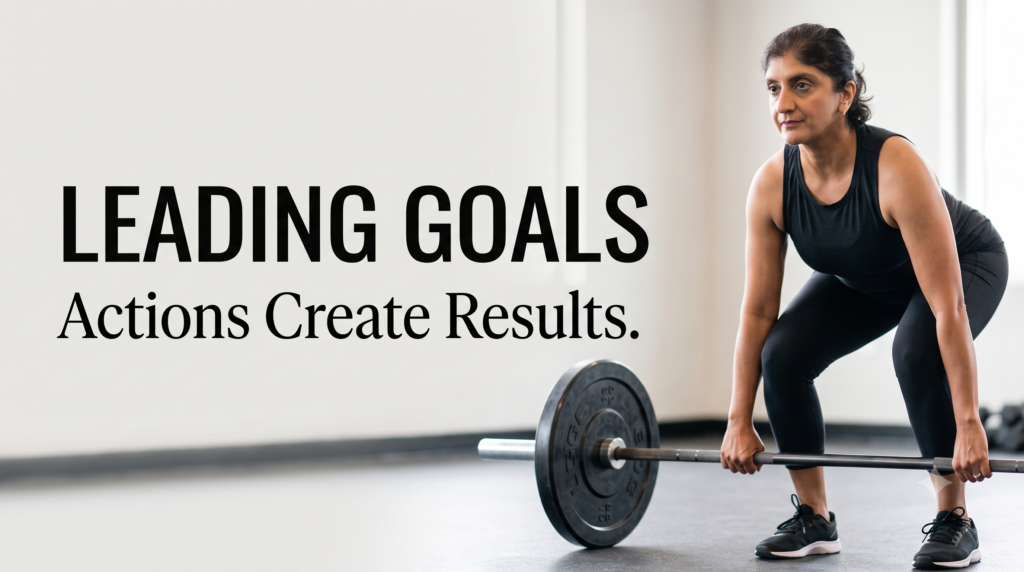
A 90 pound deadlift. That was my first exercise upon returning to my strength training routine this week.
And there’s something really important that I noticed that I want you to bring to your trading: not all goals are created equal.
I got braces about four months ago, and they kind of threw me for a loop. Because of that, I ended up pausing a lot of things in my schedule—yes, even lifting weights. But now I’m back with the same trainer at the same gym, and on my first day back she had me do a 90-pound deadlift. I was able to do 4 reps comfortably.
The funny thing was, she told me that before I stopped training I had worked my way up to 12 reps. I couldn’t believe it! But instead of focusing on getting me back to where I left off, we first talked about what kind of goal I should be setting.
Use Leading Goals for Actions
The first thing we determined was a leading goal. A leading goal—in exercise, trading, or really anywhere else—is something that’s tied to the actions you take, not the results you achieve.
So instead of saying, “Let’s get you back to 12 reps,” she said, “Let’s make a goal of doing deadlifts every week. I want you to do at least 4 reps at 90 pounds each week, and we’ll go from there.” I already know I can lift the 90 pounds. At this point, it’s really just a matter of being consistent.
That’s why I like leading goals. They’re a little less intimidating because they’re based on something you can actually control. You’re not asking yourself to produce a certain outcome today. You’re simply committing to the next action.
In trading, maybe your leading goal is waking up at a certain time so you have enough time to prepare before the market opens. Maybe it’s setting aside time every day to review your trades or your open positions. Those are all leading goals because they’re focused on the behaviors you repeat, not on whether the market rewards you immediately.
Set Lagging Goals for Results
However, if you really want to get to the next level—whether it’s strength training or trading—I think lagging goals are really valuable too. A lagging goal is tied to results. Think weight lost, money made, trophy won.
After we’d been at the gym for about 10 minutes and I was getting a little more comfortable, my trainer and I started talking about what kind of lagging goal I should set. She said, “I think we can get you to deadlifting your body weight.”
My jaw dropped, but I kept listening.
Nikki explained that it’s a really important fitness milestone. It’s a good sign of overall strength and something women should absolutely be able to accomplish with the right training. So I asked her how long she thought it would take.
“Two or three months.”
I laughed and said, “I’m a trader. I think in market intervals. Let’s call it one quarter.” 😂
Now I have something concrete to work toward. Within the next three months, my goal is to deadlift my body weight, shooting for 12 reps. That’s actually really exciting because while I still have the leading goal of showing up every week and doing the work, I now also have a lagging goal, a meaningful milestone that all of those workouts are pointing toward.
Think about your own trading and where you could apply lagging goals.
The most obvious example is how much money you want to make. But don’t just say, “I want to make a certain amount of money.” Give it a timeframe. I’ve found that goals work much better—especially lagging goals—when there’s a period attached to them.
The interesting thing is that the goal itself isn’t really the important part. As Gary Keller says in The ONE Thing, the importance of the goal is that it helps you be appropriate in the moment. I really like that idea.
A lagging goal is based on a result, so you can’t directly control it. But when you know what you’re working toward, and you’ve given yourself a realistic timeframe, you’re much more likely to take the appropriate actions day to day. The goal starts influencing the small decisions you make along the way.
Putting the Two Together
As for me, if I want to reach that bodyweight deadlift goal, I already know there are other things I’m going to have to take much more seriously.
I’ll have to pay more attention to my conditioning, my recovery, and my nutrition. I’ll also have to stay on top of the leading goals that support the bigger result. One without the other probably isn’t enough.
That’s why I think leading and lagging goals work so well together. One keeps you focused on the actions you can control today. The other gives those actions direction over time.
Whether it’s your trading, your fitness, or really anything else you’re trying to improve, I think they’re worth setting.
👉 PS — Trader Trainings Coming Up!
The Trader Training calendar has been updated! Here’s what’s on deck:
Visit himareddy.com/events for full details and registration.

Leave a Reply