
I miss Rick Santelli.
As you may know, Rick was a member of the CNBC team, and for as long as I can remember, he’s been the person I turn on the television to listen to when important economic data comes out.
He retired from his full-time role on October 2, and I’m still getting used to not hearing his voice at 8:30 in the morning!
And while Steve Liesman, who’s been covering more of these reports on CNBC, I’m sure will do a fine job, I thought I’d take this opportunity to remind you — and myself — what’s important when it comes to jobs data.
I’m no economist, but as a trader, I do have a sense of why these reports matter.
Jobless Claims: Are People Getting Fired?
Something Steve Liesman said today when discussing the weekly jobless claims report was essentially that this data helps us understand whether people are being fired.
And that’s true. Every Thursday, typically at 8:30 AM Eastern, we get the weekly initial jobless claims number, which tells us how many people filed new claims for unemployment insurance benefits, presumably because they lost their job and are in the midst of looking for a new one.
But think about how many people might lose their jobs and never file for benefits. Maybe they don’t qualify, maybe they don’t bother, or maybe they find another job before they feel the need to apply.
Those people wouldn’t necessarily show up in the weekly jobless claims numbers.
So while this data can tell us something about what’s happening with layoffs, it’s not a complete picture of everyone who’s losing a job.
And that brings us to the flip side of the equation.
The Monthly Jobs Report: What’s Happening With Employment?
Tomorrow, Friday, November 6 at 8:30 AM Eastern, we have the next monthly Employment Situation report. Or as my Wall Street colleagues and I used to joke, it’s “unenjoyment Friday”.
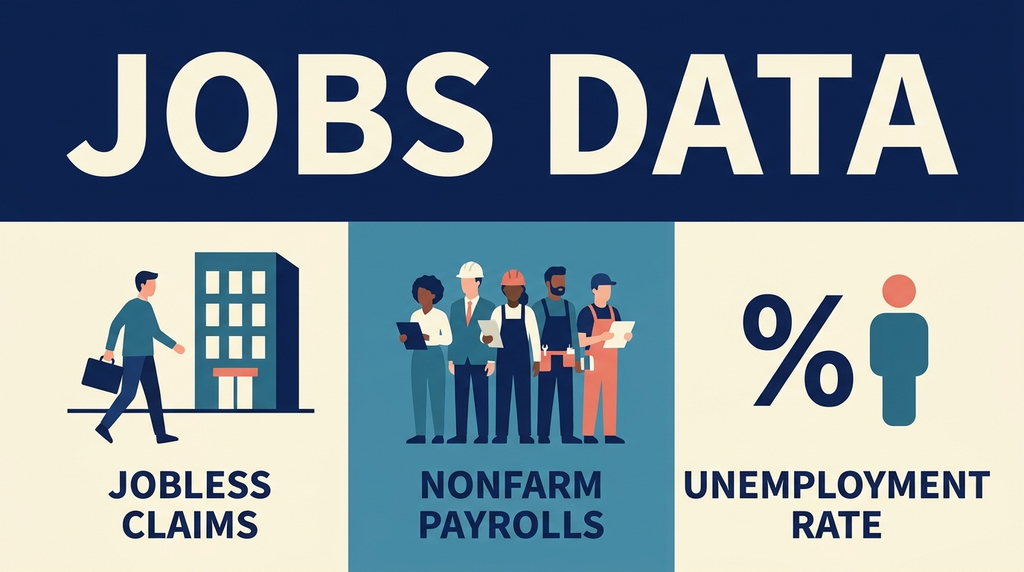
This is one of the big economic reports traders should be aware of. There’s actually a slew of data in this report, but two of the most important pieces are nonfarm payrolls and the unemployment rate.
Nonfarm payrolls measure the change in the number of jobs on employer payrolls, excluding certain categories like farm workers and the self-employed.
In other words, we’re looking at whether the economy is adding jobs or losing jobs overall.
Now, there’s a distinction here that’s worth understanding. The nonfarm payroll number isn’t simply a count of how many people got hired. It’s the net change in payroll employment, reflecting jobs added and jobs lost.
And while this data comes from surveys of employers, rather than simply counting everyone who got a new job, it gives us another way to understand what’s happening in the labor market.
The unemployment rate, on the other hand, comes from a separate survey of households. And importantly, someone doesn’t have to be collecting unemployment benefits to be counted as unemployed.
So these are different ways of measuring what’s going on, and neither one tells us everything by itself.
There’s also something else I like to pay attention to in the nonfarm payroll numbers, and that’s the difference between private-sector jobs and government jobs.
Because there are times when government hiring or layoffs can have a meaningful impact on the overall number. And I think it’s important to understand whether job growth is coming from private businesses or government employment.
That can give us a little more context about the strength of the economy.
Why Does the Fed Care About Jobs Data?
One of the reasons these reports are so important is that the Federal Reserve has a dual mandate: maximum employment and stable prices.
So the Fed is constantly looking at what’s happening with employment, along with inflation and other economic data, to help determine monetary policy.
If the labor market is extremely tight, meaning there are lots of jobs available but not enough people to fill them, that can put upward pressure on wages and potentially inflation.
On the flip side, if hiring slows significantly and unemployment starts rising, that can signal weakness in the economy.
Of course, none of these reports is perfect. They’re estimates, they can be revised, and they don’t always tell the whole story.
But they’re among the important pieces of information the Fed has to work with when making decisions about interest rates.
And as traders, we know how much those decisions can matter to the markets.
What Should Traders Actually Do With This Information?
Here’s what I really want you to take away from all of this.
You don’t need to become an economist to trade the markets.
But you do need to be aware of when important economic reports are coming out, because they can create volatility and sometimes pretty significant market shocks.
That’s why I always encourage traders to check their economic calendars. My go to is https://www.forexfactory.com/calendar.
And when you’re looking at any of these reports, there are three things I want you to pay attention to:
- The forecast: What were economists expecting the number to be?
- The previous reading: What was last week’s or last month’s number, and have there been any revisions?
- The actual number: What was reported when the data came out?
Because here’s the thing: it’s not necessarily whether a number is good or bad that moves the market. It’s often how that number compares to what everyone was expecting.
And even then, the market’s reaction isn’t always what you might think it should be!
So my point isn’t that you should try to predict where the market is going based on the jobs numbers.
It’s that you should understand what these reports are measuring, know when they’re coming out, and be prepared for the volatility that can follow.
I’m no Rick Santelli, but hey, it’s a start!
Hopefully, this helps you navigate jobs data a little better.
📅 PS — First 40 Library Training TODAY!
Our next First 40 Trading Club Library Training is happening TODAY, November 5, from 4:30–5:30 PM ET!
We’ll be covering Bringing Trading Course Techniques into Your Trading Plan, helping members take what they’re learning and put it into practice.
This training is exclusively for current First 40 Trading Club members.
Visit himareddy.com/events for all our upcoming events!

Leave a Reply